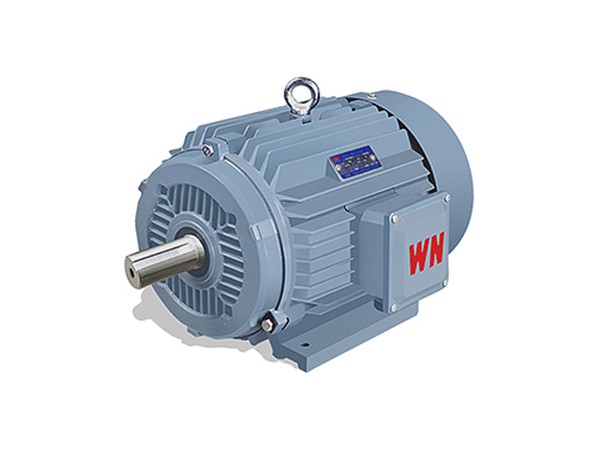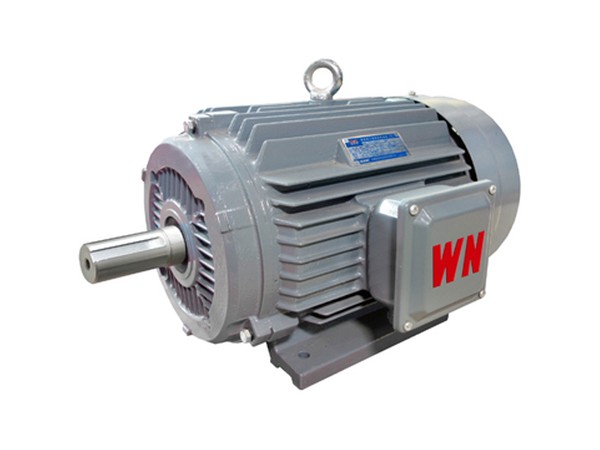
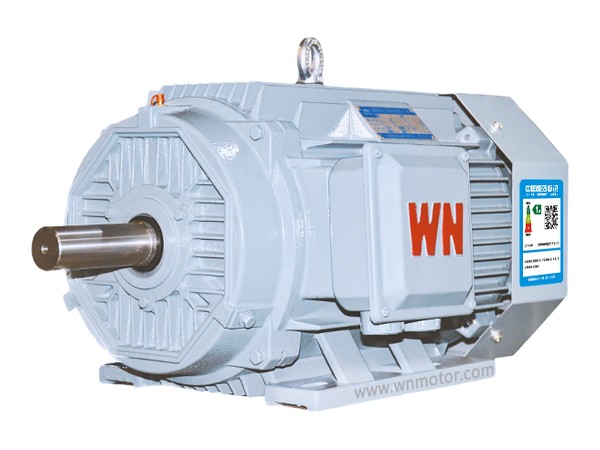
YE5 · IE5
0.75–375 kW · frame 80–355
Motors · IE3 to IE5 · 0.12–2,500 kW
High-efficiency asynchronous motors from 0.12 to 375 kW at 380 V and 160 to 2,500 kW at 6/10 kV, plus permanent-magnet synchronous motors to 450 kW. One efficiency step is 15–20% of the motor losses; two steps pay for themselves long before the pump does.
On a 24/7 duty the motor runs more hours than anything else on the skid, and it runs them at whatever efficiency class it was bought at. A pump selected for 85% hydraulic efficiency is bolted to a motor that may be 89% efficient — the train number is the product, not the pump number alone.
This is why we now quote the drive end with the pump end: motor, coupling, baseplate and, where the duty varies, the variable-frequency drive. One train, one set of drawings, one warranty.
Every efficiency step removes about a fifth of the losses. IE3 → IE4 is roughly 15–20% of motor losses; IE4 → IE5 is another 20%. On continuous duty that is the cheapest kilowatt-hour you will ever buy — no civil works, no pipework, no shutdown beyond the swap.
The low-voltage series below follow IEC 60034 dimensions: the same frame number means the same shaft height, foot holes and flange pattern as the motor you are replacing. A YE3 or YX3 unit comes out, a YE5 goes in on the same baseplate, with the same coupling alignment.
Type spectrum
The listing follows the Wannan Electric (皖南电机) catalogue — the mainstream Chinese type spectrum for these frames. If your drawing or spare-parts list already says YE3-280M-4 or TYCP-315, you can read the equivalent straight off the tables below.
Bought on its own
Most of the motors we ship to Malaysia and Indonesia go into palm oil mills as single replacement units: one motor in a crate, a test report with it, landing on a baseplate poured twenty years ago. We match the frame, not the catalogue number.
A screw press stops on a Tuesday. The mill needs a 4-pole motor with the same foot holes, the same shaft height and the same shaft extension, running before the weekend. That is not a pump project and we do not treat it as one: it is a single unit, nameplate-matched, crated and shipped.
Malaysian mills are normally 415 V / 50 Hz; Indonesian mills are 380 V or 415 V / 50 Hz, with 60 Hz gensets on some isolated lines. All of these are standard builds for us — the motor is wound for the supply on site, not for a generic export voltage.
Send the photo and we reply with the equivalent model, a frame check against the baseplate, the price and the lead time. If the old frame is obsolete, we say what has to change before anything is ordered.
| Palm oil mill drive | What usually decides the motor | What we match |
|---|---|---|
| Sterilizer / cage hauling | Frequent starts, brake or geared drive, hot and wet surroundings | Frame and shaft, brake torque, IP55, VFD duty if the drive stays |
| Screw press | High starting torque, continuous duty, heavy radial load | Foot or flange pattern, shaft extension, thermal margin |
| Thresher / bunch crusher | High inertia at start, shock load in service | Frame, starting torque, IE3 or IE4 equivalent |
| Kernel plant — crusher, separator, winnower | Dust, continuous running, small frames | Frame 80–200, IP55, IE3 / IE4 |
| EFB shredder / press | Very high inertia, load swings, long acceleration | VFD duty with independent fan; thermal margin stated, not assumed |
| Boiler feed and process pumps | Continuous duty, pressure controlled by speed | 2- or 4-pole, VFD duty, motor alone or pump-and-motor |
| Sludge, desander and POME pumps | Moisture, corrosive atmosphere, intermittent running | IP55 / IP65, moisture-resistant winding, frame match |
The table is a checklist, not a selection: the rating is read off the nameplate and the driven machine, not off the equipment name. Where a mill replaces an IE1 or IE2 motor, the IE3 or IE4 equivalent is normally the same frame — the efficiency step costs nothing in civil works.
Family 1
Squirrel-cage, totally enclosed fan cooled, cast-iron frame. The default drive for pumps, fans, compressors, conveyors and crushers — and the only family that can be dropped straight onto an existing baseplate without changing the drive.
| Series | Efficiency class | Power | Frame | Poles | Where it is used |
|---|---|---|---|---|---|
| YE5 | GB 18613-2020 Grade 1 (IE5) | 0.75–375 kW | 80–355 | 2, 4, 6, 8 | Continuous duty where the kWh bill dominates — boiler feed, mine dewatering, aeration, pipeline transfer |
| YE4 | GB 18613-2020 Grade 2 (IE4) | 0.37–375 kW | 63–355 | 2, 4, 6, 8 | The practical default when lead time or price rules out IE5 |
| YE3 | GB 18613-2020 Grade 3 (IE3) | 0.12–375 kW | 63–355 | 2, 4, 6, 8, 10 | General purpose and like-for-like replacement of the installed fleet |
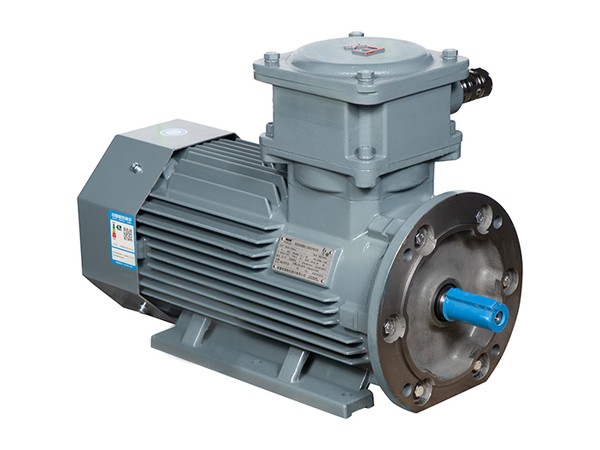
| YBX5 | GB 18613-2020 Grade 1 (IE5), Ex d | 0.18–375 kW | 80–355 | 2, 4, 6, 8 | Flammable-gas areas — gas boosting, refinery, paint and solvent plants |
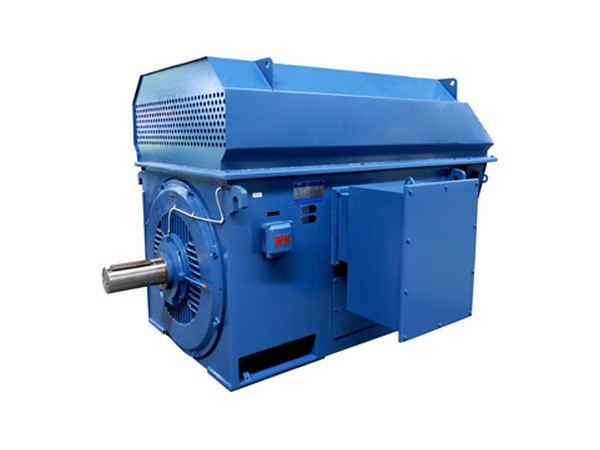
| YKK | High efficiency, 6/10 kV | 160–2,500 kW | 355–630 | 2–12 | Large pump and fan drives where 380 V cable and switchgear stop making sense |
Standard: 380 V / 50 Hz (other voltages and 60 Hz to order) · S1 duty · IP55 · F class · IC411 · B3 / B5 / B35 / V1 mounting. Derivatives available on the same platform: VFD-duty (YVF2 / YXVF), electromagnetic brake, multi-speed, low-vibration, marine, roller-table and stainless-steel shell.
Efficiency, in plain numbers
At 110 kW, 4-pole, the difference between IE3 and IE5 is about 1.1 percentage points of efficiency. That sounds small until it is multiplied by 8,000 hours a year: roughly 1.3 kW of continuous loss removed, about 10,400 kWh a year, about US$1,040 a year at US$0.10/kWh — per motor.
Indicative efficiencies; the exact value for a given model and voltage is taken from its type-test data and issued with the datasheet.
High voltage
Above roughly 300 kW the cable and switchgear for a 380 V motor become the expensive part of the installation. The YKK series runs at 6 kV or 10 kV, in a welded steel frame with a top-mounted air-to-air cooler and VPI insulation — 160–2,500 kW, 2 to 12 poles, IP44/IP54/IP55, F or H class, IMB3 or IMB35.
Family 2
A rotor with permanent magnets instead of an induced cage. Higher efficiency and higher power density in the same frame — and a much wider efficient band at part load, which is exactly where a pump or fan actually runs.
| Series | Efficiency class | Power | Frame | Voltage | Cooling |
|---|---|---|---|---|---|
| TYCP | GB 30253-2013 Grade 1 | 0.55–375 kW | 80–355 | 380 V | IC411, IC416 at ≥55 kW / 3,000 rpm |
| TYCP2 | GB 30253-2013 Grade 1 | 0.55–450 kW | 80–355 | 380 V | IC411 |
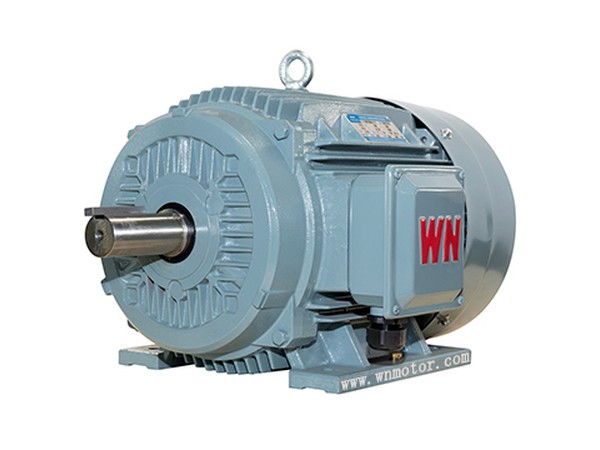
An induction rotor has to be magnetised by the stator — that magnetising current is a standing loss whether the shaft is loaded or not. A permanent-magnet rotor supplies its own field, so the efficiency curve stays flat from about 25% to 120% load. On a pump running at 60–80% of design flow for most of the year, that is where the saving is.
The trade-off is honest: a PM motor must run from a drive. It cannot be started across the line. If the existing installation has no VFD, the drive has to be added, and that changes the payback — often still positive, but it has to be calculated, not assumed.
TYCP series mounting dimensions match the YE2 / YX3 / YE3 / YE4 induction frames, so a PM motor goes onto the existing baseplate and coupling without re-machining. TYCP2 raises power density further — up to 450 kW in the same 80–355 frame range — so a smaller motor can carry a duty that previously needed the next frame up.
Selection guide · indicative
A starting point for reading a nameplate or sketching a layout. The definitive table is per series and per voltage; we issue it with the quotation.
| Frame | 80 | 90 | 100 | 112 | 132 | 160 | 180 | 200 | 225 | 250 | 280 | 315 | 355 |
|---|---|---|---|---|---|---|---|---|---|---|---|---|---|
| kW at 4-pole | 0.55–0.75 | 1.1–1.5 | 2.2–3.0 | 4.0 | 5.5–7.5 | 11–15 | 18.5–22 | 30 | 37–45 | 55 | 75–90 | 110–132 | 160–375 |
| IE5 availability | ● | ● | ● | ● | ● | ● | ● | ● | ● | ● | ● | ● | ● |
2-, 6-, 8- and 10-pole machines cover the same frames at different speeds and powers; explosion-proof and high-voltage frames follow their own tables. Where a duty falls between frames, the choice is made on starting torque, thermal margin and the driven machine's inertia — not on price alone.
Send the nameplate photo of the motor you are replacing and we will come back with the equivalent model, its efficiency class and the annual kWh difference at your running hours.
A motor is a product line for us, not an accessory. It can ship as a single replacement unit against a nameplate — that is the usual order from a palm oil mill — or as part of a complete train: pump, motor, coupling and guard, baseplate, VFD or starter, instrumentation and control panel, assembled, aligned and tested before shipment.
For a replacement motor on an existing pump, we work from the nameplate and the driven curve, and confirm the frame will land on the existing baseplate before anything is ordered.
Compliance
Efficiency classes are stated against the Chinese mandatory standards GB 18613-2020 (asynchronous) and GB 30253-2013 (permanent-magnet synchronous), with the IEC 60034-30-1 equivalent given for reference. Certificates for a specific market — CE, EAC, UL/CSA or a hazardous-area approval — are quoted item by item against the motor, the voltage and the country it will be installed in. We do not describe a motor as certified for a market where that approval has not been issued for the delivered configuration.
Frame, power, speed and efficiency class are all we need to start. We answer with the equivalent high-efficiency model, the frame check, and the annual kWh difference at your running hours.